Critical Minerals Shortage Looms for Energy Transition by 2035, Insights from GEM Mining Consulting
GEM Mining Consulting indicates a potential shortfall in critical minerals essential for the energy transition by 2035, with significant supply chain vulnerabilities.
The impending energy transition is facing a serious challenge: a critical minerals shortage expected by 2035. According to a recent report from GEM Mining Consulting based in Santiago, Chile, the future supply of essential minerals may be compromised not only by extraction rates but also by significant processing bottlenecks and unreliable project forecasts. These issues raise concerns about the capability to meet increasing demand for lithium, cobalt, copper, and other crucial materials.
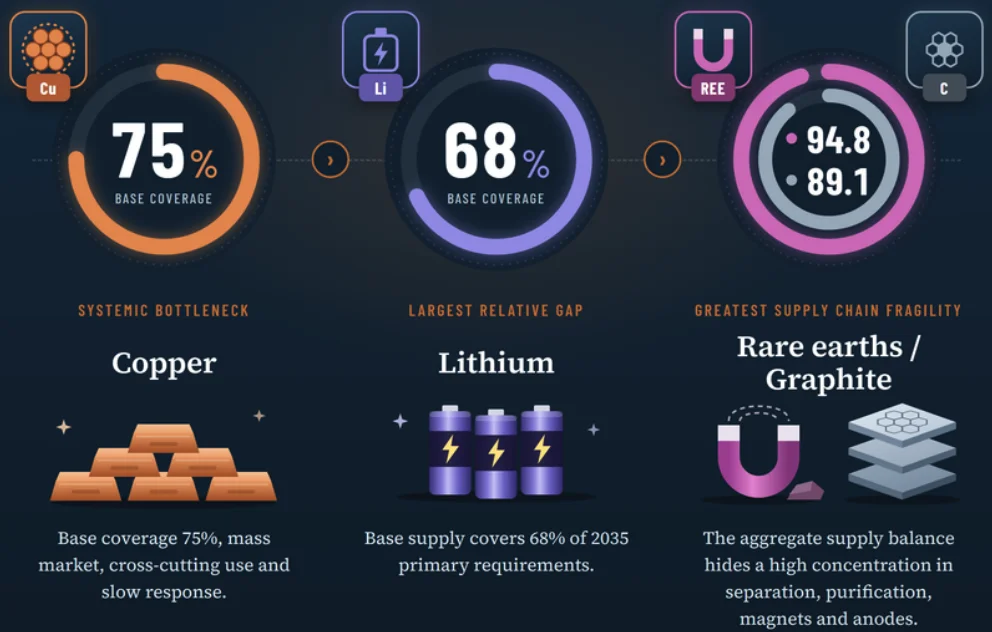
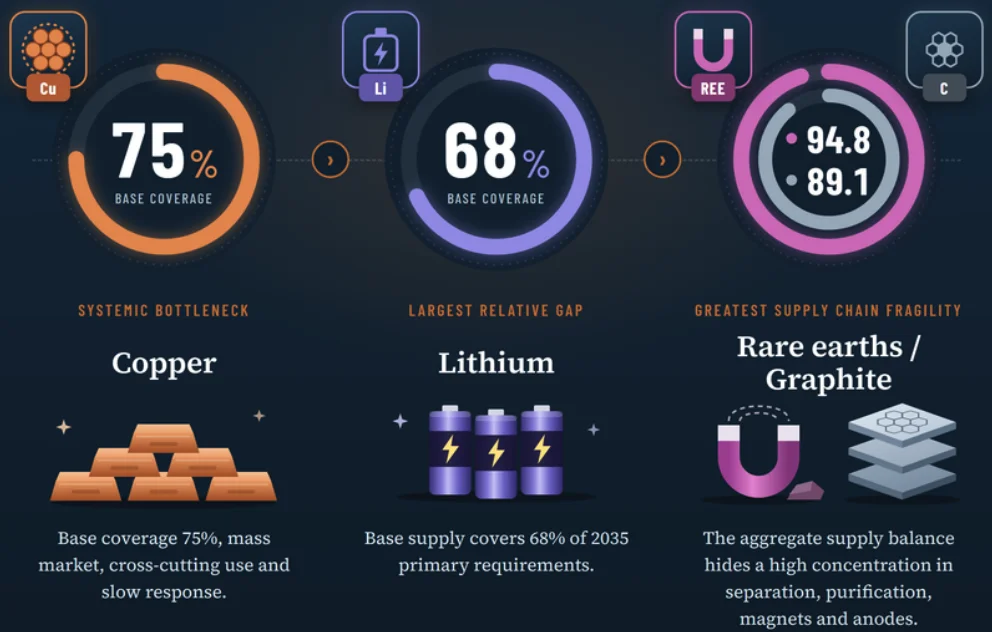
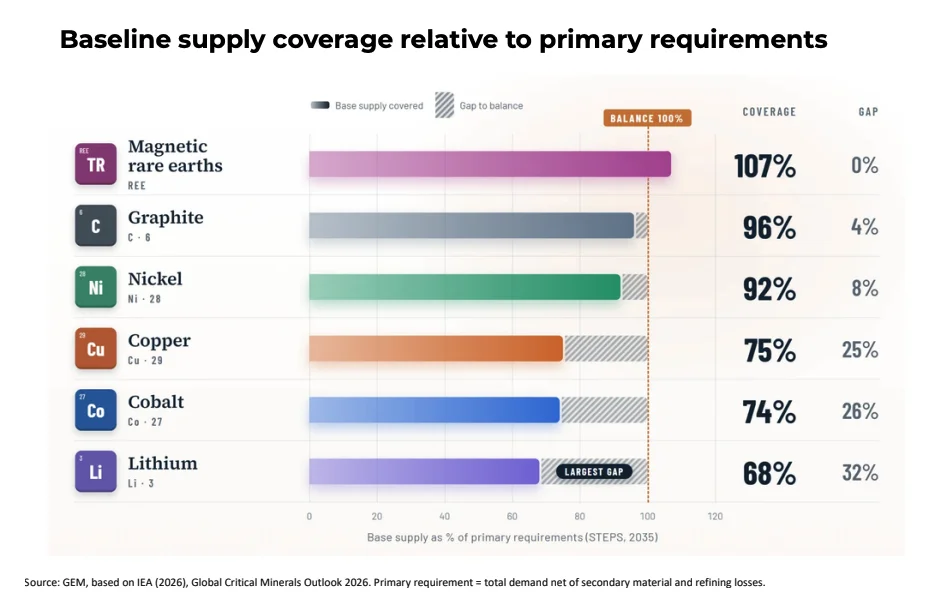
GEM's analysis reveals sobering projections for individual minerals. It estimates that by 2035, supply will only cover 68% of lithium demand, which is notably lower than the anticipated coverage for cobalt and copper, which are forecasted at 74% and 75%, respectively. In contrast, despite graphite and rare earth elements appearing to have sufficient projected volumes, the concentration of processing capacity in China heightens supply chain risks for these materials.
In the report, GEM emphasizes, “A reserve becomes strategically relevant only when it can be financed, permitted, extracted, processed, qualified and delivered through a resilient supply chain.” This statement highlights the complexity involved in transforming mineral resources into usable supplies, stressing that merely identifying reserves isn't enough.
Assessing Supply Risks
GEM introduces two critical indices to better account for the realities of mineral supply and demand. The first, a Volume Scarcity Index, quantifies the gap between projected supply and primary demand. The second, the Supply Chain Fragility Index, evaluates vulnerabilities such as the concentration of processing activities, technological dependencies, and geographic risks associated with mineral sourcing.
Within these assessments, lithium emerges as the most constrained mineral, registering a high score of 80 on GEM’s scarcity index. Cobalt and copper score 65 and 62, respectively. However, when examining supply chain vulnerabilities, rare earth magnets and battery-grade graphite score alarmingly high on the fragility index—95 and 89 out of 100—despite projections indicating that supply will meet demand at 107% and 96%, respectively, by 2035. This indicates that even seemingly sufficient supply can mask serious processing risks.
Among other minerals, cobalt scores 78 for fragility, with nickel at 66. The concentrations of processing activities in countries like Indonesia and China further complicate these figures. In contrast, copper, despite its impending physical deficit, scores a comparatively low 36 on the fragility scale. This nuanced understanding suggests that the largest projected supply deficits do not automatically equate to the highest strategic vulnerabilities.
As GEM posits, the priority for lithium, cobalt, and copper is to ensure the reliable commencement of new mining production, while for graphite and rare earths, the focus should shift toward diversifying processing capabilities beyond dominant producers like China.
Misleading Projections
One of the crucial insights GEM offers is the potential misleading nature of announced project capacities. For instance, a hypothetical project anticipated to produce an annual output of 100,000 tonnes might realistically yield only about 60,200 tonnes of dependable, marketable material after accounting for a variety of operational challenges—representing a nearly 40% shortfall.
Throughout the lifecycle of a mining project, losses can accrue from a number of stages including permitting, financing, and development risks. It often takes considerable time for a mining project to achieve its projected nameplate capacity, and metallurgical processes may reduce the amount of viable output. Furthermore, any material exiting a processing facility must meet stringent chemical and technical standards demanded by battery, magnet, and other manufacturing sectors.
The implications of these findings are significant for policymakers and investors seeking to secure reliable supplies of critical minerals. The report argues that understanding the true availability of minerals requires looking beyond raw resource estimates and allowing processing infrastructure, financing dynamics, technical performance, and qualifying capabilities to dictate market viability.
For miners and investors, this indicates a paradigm shift in valuation methods. A smaller mine that has established proven processes and a dependable customer base may be more strategically vital than a larger resource that lacks a reliable path to market. Essentially, the energy transition’s success in securing vital minerals may hinge as much on effective post-extraction processes as it does on the extraction itself.