D.C., Arizona, and Colorado Stand Out in Business AI Adoption Rates
Washington, D.C., Arizona, and Colorado lead in business AI utilization according to a recent analysis, highlighting significant regional disparities.
As businesses across the United States increasingly adopt artificial intelligence (AI) technologies, a recent report by Resume Now has provided insights into the state-level usage of AI during the first half of 2026. The analysis reveals significant variations, showcasing Washington, D.C., Arizona, and Colorado as the front-runners in reported AI integration within business practices. This disparity raises questions about the future of workforce dynamics and regional competitiveness in the face of rapid technological change.
Report Overview
The report, titled America’s Workplace AI Temp Check, leverages data from the U.S. Census Bureau’s Business Trends and Outlook Survey. By employing the Resume Now AI Thermometer, the analysis ranks states based on the percentage of businesses reporting the use of AI in at least one function. The established baseline for the analysis was found to be 18.9%, derived from the average AI usage reported across 48 states and Washington, D.C.

This baseline reflects a growing trend, but the challenge lies in interpreting what this means for businesses and their employees. AI's role isn't just about efficiency; it's about adaptation and survival in a competitive market. Companies that embrace these technologies may not only improve their processes but also position themselves as leaders in their respective industries. Those that lag risk being left behind as the market evolves.

Key Insights from the Analysis
The findings of the analysis can be broken down into several key insights that speak volumes about the current state of AI integration:

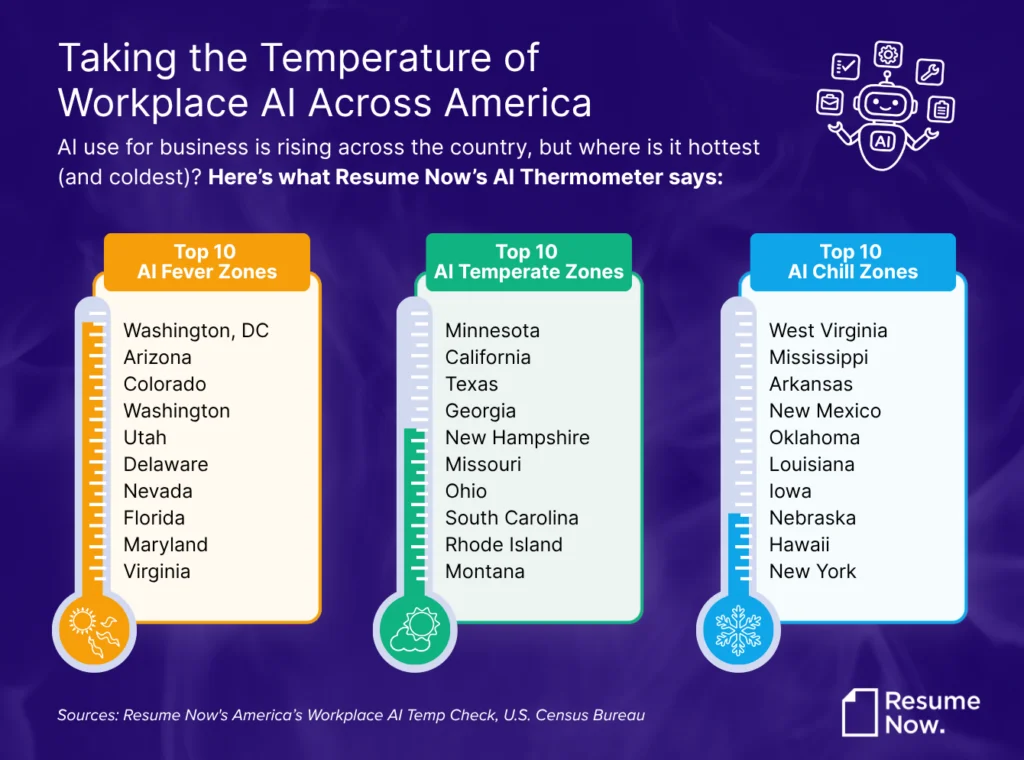
- Washington, D.C., Shows the Highest Usage: With an impressive 27.7% of businesses reporting AI utilization, Washington, D.C. leads the pack, surpassing the baseline by 8.8 percentage points. This dominance suggests a concentrated effort among businesses in the capital to leverage technology for enhanced decision-making and operational efficiency.
- Arizona and Colorado Close Behind: Arizona comes in second with 24.4% of businesses adopting AI, while Colorado follows closely at 24.0%, both significantly above the baseline. These figures expose a trend of progressive adoption in this region, likely driven by supportive local policies and vibrant tech ecosystems. Such environments encourage experimentation and growth in AI strategies, which can lead to a skilled labor force that's in high demand.
- Emerging Temperate Zones: Minnesota emerged as a leader in the AI Temperate Zone, with 20.9% of its businesses reporting AI use. This group includes other states like California and Texas, both at 20.8%. Interestingly, these states are known for their tech hubs and entrepreneurial spirit, which typically facilitate the infusion of AI strategies across various sectors. The presence of educational institutions and research centers may also play a role in upskilling the workforce.
- Lowest Adoption in AI Chill Zones: Conversely, West Virginia reported the lowest adoption rate at just 13.5%, followed closely by Mississippi at 13.7% and Arkansas at 14.3%. This discrepancy highlights concerning trends for businesses in these states, where sluggish adoption of AI could signify broader economic challenges. If these regions fail to catch up, they might face long-term impacts on job creation and innovation, putting them at a disadvantage nationally.
AI Fever Zones
AI Fever Zones are designated states where the reported business AI usage is at least 2 percentage points above the baseline. Washington, D.C. not only holds the highest ranking but is also the only jurisdiction that is not a state. Arizona and Colorado embody strong adoption rates among traditional states, revealing a trend of progressive AI integration in their business environments. This trend isn’t just a tech phenomenon; it's reshaping how industries compete and thrive.

| State/Jurisdiction | Average % of Businesses Reporting AI Use | Distance From Thermometer Baseline | |
| 1 | Washington, D.C. | 27.7% | +8.8 points |
| 2 | Arizona | 24.4% | +5.5 points |
| 3 | Colorado | 24.0% | +5.1 points |
| 4 | Washington | 23.1% | +4.2 points |
| 5 | Utah | 22.9% | +4.0 points |
AI Temperate Zones
AI Temperate Zones capture states whose reported business AI use sits within a 2 percentage point margin around the baseline. Minnesota is slightly ahead in this category, emphasizing a healthy level of AI integration while remaining just shy of the “fever” classification. This positioning suggests both opportunity and risk, as businesses here may want to push boundaries further to ensure they don’t fall behind.

| State/Jurisdiction | Average % of Businesses Reporting AI Use | Distance From Thermometer Baseline | |
| 1 | Minnesota | 20.9% | +1.97 points |
| 2 | California | 20.8% | +1.9 points |
| 2 | Texas | 20.8% | +1.9 points |
| 4 | Georgia | 20.5% | +1.6 points |
| 5 | New Hampshire | 20.5% | +1.6 points |
AI Chill Zones
States falling under AI Chill Zones report less than 2 percentage points below the baseline, indicating a notable lag in AI adoption. This pattern could become a significant liability, particularly for businesses that rely on data-driven decision-making to remain competitive. Refusing to adapt to technological needs isn't just a strategy choice—it's a risk.

| State/Jurisdiction | Average % of Businesses Reporting AI Use | Distance From Thermometer Baseline | |
| 1 | West Virginia | 13.5% | -5.4 points |
| 2 | Mississippi | 13.7% | -5.2 points |
| 3 | Arkansas | 14.3% | -4.6 points |
| 4 | New Mexico | 14.7% | -4.2 points |
| 5 | Oklahoma | 14.9% | -4.0 points |
Regional Insights and Future Implications
With clear discrepancies in AI adoption across various states, there are essential implications for businesses and employees alike. As highlighted by Keith Spencer, a career expert at Resume Now, understanding the uneven adoption of AI tools can shape worker experiences and career paths in different regions. This disparity not only emphasizes the importance of regional policies and economic conditions impacting technology adoption but also outlines potential areas where additional support and resources may be required.

If you're working in this space, the need for adaptation is urgent. Jobs in tech-savvy states are likely evolving faster, giving workers there an edge over their peers in less integrated areas. Companies should take note: the financial landscape of tomorrow favors those who embrace technology today.

This analysis isn't just data points on a graph. It’s a wake-up call. Companies and policymakers need to consider these findings seriously. Areas lagging in AI integration could see declining economic health, as businesses struggle to compete without the benefits of improved efficiencies and new capabilities. The future isn’t just tech; it’s strategic. Organizations must act, or risk falling behind.

To explore the full analysis and discover more about America’s Workplace AI Temp Check, you can access the detailed report here.